Research
Four interconnected themes spanning meta-optics, imaging, and quantum photonics.
Meta-optic Computational Imaging
Depth, polarization, spectrum, complex amplitude, and 3D/4D imaging
01 Scientific Challenge
Conventional cameras capture only light intensity, discarding rich dimensional information such as depth, polarization, spectrum, and phase. Recovering these dimensions typically requires bulky lens assemblies, multiple exposures, or active illumination, which limits system miniaturization and real-time performance.
02 Our Approach
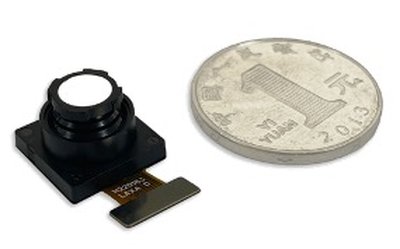
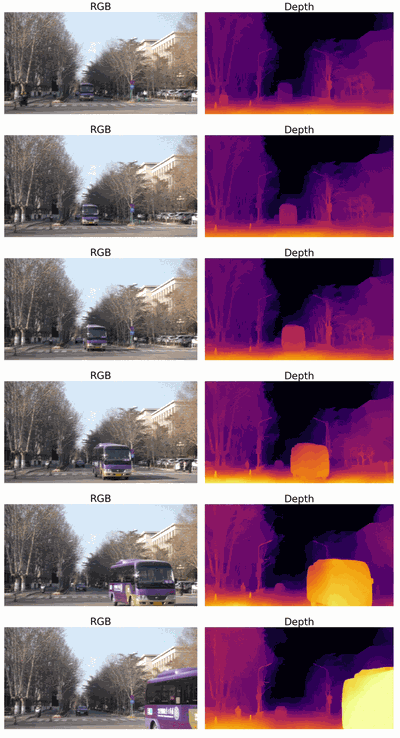
We replace conventional lens sets with single-layer metasurfaces that simultaneously encode multiple dimensional information into a single intensity snapshot. By engineering the polarization-, wavelength-, and angle-dependent response of subwavelength meta-atoms, and pairing them with task-specific computational reconstruction algorithms, we achieve compact, single-shot multidimensional imaging.
03 Representative Result
We have demonstrated metasurface-based single-shot depth sensing, full-Stokes polarimetry, snapshot hyperspectral imaging, complex-amplitude microscopy, and extended-scene monocular 3D imaging. These works achieve performance comparable to or exceeding conventional systems while reducing the optical volume by orders of magnitude.
04 Selected Publications
- [5]Monocular complex amplitude imaging via a polarization-multiplexed liquid-crystal-lens-informed Fourier neural networkNational Science Review 13(2), nwaf561 (2026)
- [10]
- [11]Metaoptic Computational ImagingACS Photonics 12, 1722 (2025)
- [12]Metasurface-generated large and arbitrary analog convolution kernels for accelerated machine visionACS Photonics 11(12), 5430-5438 (2024)
- [14]Single-shot deterministic complex amplitude imaging with a single-layer metalensScience Advances 10(1), eadl0501 (2024)
- [17]Metasurface array for single-shot spectroscopic ellipsometryLight: Science & Applications 13(1), 88 (2024)
- [20]Metalens for Accelerated Optoelectronic Edge Detection under Ambient IlluminationNano Letters 24(1), 356 (2024)
- [29]Monocular metasurface camera for passive single-shot 4D imagingNature Communications 14, 1035 (2023)
Nonlocal and Ultra-thin Imaging Optics
Imaging thickness limit, wavefront sensing, super-resolution, and spatial filtering
01 Scientific Challenge
The thickness of conventional imaging systems is fundamentally constrained by the need for free-space propagation to perform Fourier transforms and spatial filtering. This 'thickness bottleneck' prevents further miniaturization of cameras and microscopes. Additionally, wavefront sensing and super-resolution imaging typically require specialized, bulky hardware.
02 Our Approach
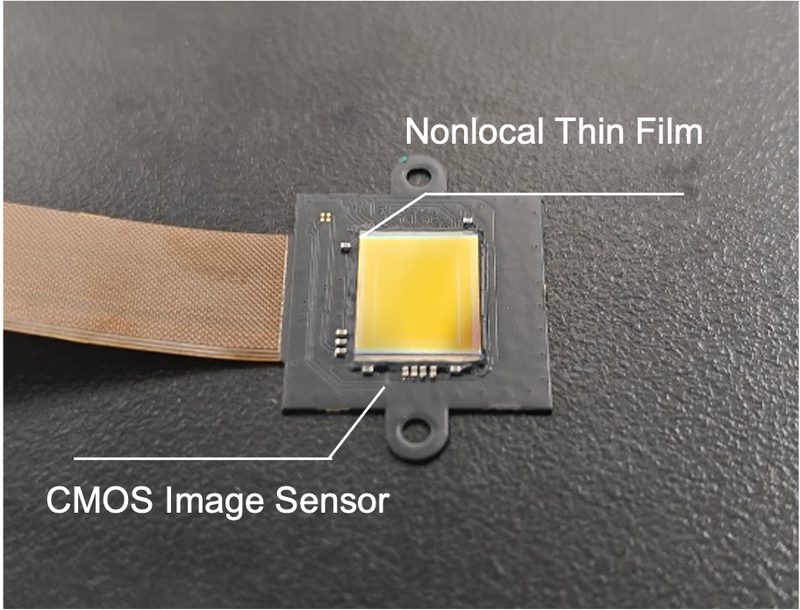
We introduce nonlocal optical response into ultra-thin metasurfaces, enabling Fourier-transform and spatial-filtering operations within a subwavelength-thick device. By engineering the spatial nonlocality of meta-atoms, we collapse the entire imaging pipeline—including focusing, filtering, and wavefront analysis—into a single flat optic. We also exploit nonlocal effects to bypass the diffraction limit and achieve far-field super-resolution.
03 Representative Result
We have demonstrated a translationally invariant metasurface that bypasses the fundamental imaging thickness limit, achieving high-quality imaging with a device hundreds of times thinner than conventional lenses. We have also demonstrated k-space superoscillation for far-field super-resolution imaging, and ultra-thin wavefront sensors with sub-microradian resolution.
04 Selected Publications
- [1]Nonlocal flat optics for motionless 3D critical dimension metrologyAdvanced Photonics 8, 056009 (2026)
- [2]Bypassing the imaging thickness limit with a translationally-invariant nonlocal thin filmNature Communications 17, 9432 (2026)
- [4]Far-field superresolution imaging via k-space superoscillationeLight 6(1), 7 (2026)
- [22]Single-Shot Wavefront Sensing with Nonlocal Thin Film Optical FiltersLaser & Photonics Reviews 17(12), 2300426 (2023)
- [35]Transmissive nonlocal multilayer thin film optical filter for image differentiationNanophotonics 10,3519 (2021)
Active and Reconfigurable Meta-optics
Liquid crystal metasurfaces, beam steering, and terahertz modulation
01 Scientific Challenge
Most metasurfaces demonstrated to date are passive, with fixed optical responses determined at fabrication time. This limits their applicability in dynamic scenarios such as beam steering for LiDAR, adaptive optics, and reconfigurable terahertz systems. Integrating active materials with metasurfaces while maintaining high efficiency and fast switching speed remains a key challenge.
02 Our Approach
We integrate liquid crystals, phase-change materials, and semiconductor heterostructures with metasurfaces to achieve electrical, thermal, or optical reconfigurability. For liquid crystal metasurfaces, we engineer the interaction between the LC director field and the metasurface resonance to achieve large phase modulation with low driving voltage. For terahertz devices, we use graphene and semiconductor metamaterials for high-speed modulation.
03 Representative Result
We have demonstrated liquid crystal metasurfaces with continuous 2π phase tuning, beam steering devices with >60° scanning range, and terahertz modulators with >90% modulation depth at GHz switching speeds. These devices enable applications in solid-state LiDAR, adaptive optics, and next-generation wireless communications.
04 Selected Publications
- [6]220-GHz Liquid Crystal RIS-Aided Multi-User Terahertz Communication System: Prototype Design and Over-the-Air Experimental TrialsIEEE Transactions on Wireless Communications 25, 8534 (2026)
- [13]Liquid Crystal Metasurface for On-Demand Terahertz Beam Forming Over 110° Field-Of-ViewLaser & Photonics Reviews 18(9), 2400237 (2024)
- [33]Computational spectropolarimetry with a tunable liquid crystal metasurfaceeLight 2, 23 (2022)
Nonlinear and Quantum Meta-optics
ENZ, harmonic and terahertz generation, and entangled photon states
01 Scientific Challenge
Nonlinear optical processes traditionally require bulky crystals with strict phase-matching conditions and high pump powers. Similarly, quantum photonics relies on parametric down-conversion in nonlinear crystals, which are inherently large and difficult to integrate. Epsilon-near-zero (ENZ) materials offer a platform for dramatically enhanced nonlinear interactions, but controlling the spectral and spatial properties of the generated light remains challenging.
02 Our Approach
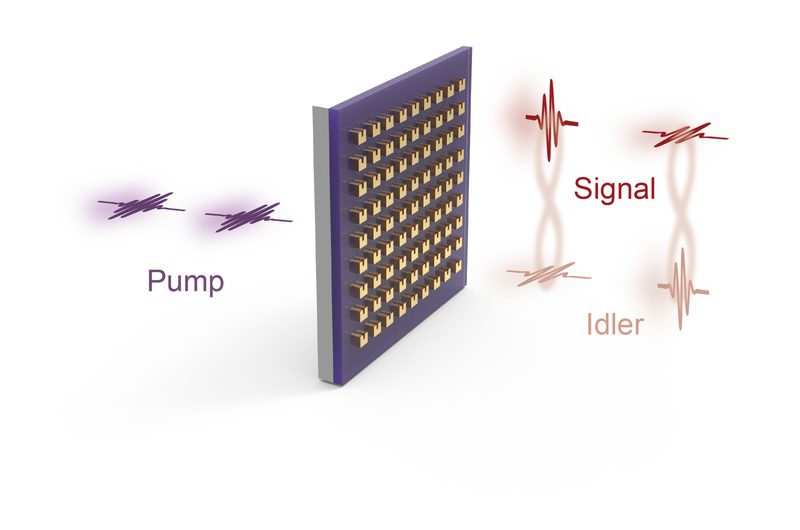
We exploit the giant field enhancement and slow-light effects in ENZ thin films to achieve efficient nonlinear frequency conversion, including high-harmonic generation and terahertz wave generation, in subwavelength-thick devices. We also engineer the nonlinear susceptibility of metasurfaces to generate polarization-entangled photon states with tailored spatial modes, enabling compact quantum light sources.
03 Representative Result
We have demonstrated subwavelength-thick ENZ films for efficient third- and fifth-harmonic generation, terahertz emitters with >1% conversion efficiency, and metasurface-based polarization-entangled Bell state generation. These works pave the way for ultra-compact nonlinear and quantum photonic devices.
04 Selected Publications
- [7]Polarization-entangled Bell state generation from an epsilon-near-zero metasurfaceScience Advances 11, eads3576 (2025)
- [21]Intracavity spatiotemporal metasurfacesAdvanced Photonics 5, 2 (2023)
- [42]Nonlinear meta-optics towards applicationsPhotoniX 2, 3 (2021)
- [45]Broadband terahertz wave generation from an epsilon-near-zero materialLight: Science & Applications 10, 11 (2021)
- [49]High-harmonic generation from an epsilon-near-zero materialNature Physics 15,1022 (2019)